
Blog

LYRIQ vs. XT5: Which Cadillac SUV Fits Your Life in Pearl?

2026 Cadillac LYRIQ and 2026 Cadillac XT5 side by side on an I-55 highway in Mississippi at dusk

Start with the bottom line. The 2026 Cadillac LYRIQ and the 2026 Cadillac XT5 aren't interchangeable answers to the same question. They answer different questions entirely. One is an established, gas-powered SUV in the final year of a generation that's served the Jackson metro well for a decade. The other is a fully electric platform that Cadillac is building its entire next chapter around. Choosing between them isn't about which one is "better." It comes down to which one matches the specific way you move through Ridgeland, Madison, and points south on I-55.

We see both in our showroom, and we spend real time with the buyers who cross-shop them. The conversation is almost never about what you get for the money. It's about which ownership model fits your week.

What Do You Actually Get at Each Tier?

Both vehicles wear the Cadillac crest and deliver a composed, refined interior, but the moment you move past that shared promise they diverge hard, with one leaning into an all-electric future and the other settling comfortably into proven, gas-powered habit that doesn't ask anything new of you. Below is the tier-by-tier breakdown, stripped of the marketing language.

Feature2026 LYRIQ (Luxury, base)2026 XT5 (Luxury, base)Who It Matters To
PowertrainAll-electric, 325 hp RWDTurbo-4, 235 hp, FWDDaily commuter vs. flexible traveler
EPA Range / Efficiency326 mi estimated (RWD)24 mpg combined (EPA)Charger-at-home vs. stops-on-the-road
Center Display33" Horizon Display, 9K LED8" touchscreenTech-forward buyer vs. keep-it-simple
Driver AssistanceSuper Cruise, standard on all trimsAdaptive cruise, blind-spot; no Super CruiseLong I-55 commute vs. city errands
Charging / Refueling190 kW DC fast, 50 mi in ~10 minFill up anywhere, anytimeHome-charger household vs. flexibility first
Cargo (behind rear seat)28.0 cu ft30.0 cu ftSimilar day-to-day; XT5 wins folded (63 cu ft)
Interior Feature HighlightSkyGlass roof, 126-color ambient lighting standardBose 8-speaker; heated seats, 18" wheelsImmersive cabin vs. refined simplicity
ConnectivityGoogle Built-In, wireless CarPlay + Android AutoWireless CarPlay + Android AutoIntegrated vs. paired
Generation StatusCurrent platform, Cadillac's EV architectureFinal year of current generationForward investment vs. proven quantity

The last row on that table deserves a word. Going forward, Cadillac is building its platform strategy around The LYRIQ. The XT5, by contrast, is finishing its current generation in 2026. A redesign is due next year. None of that is a knock on the XT5; it still delivers everything it promised, and the 2026 model year received meaningful driver-assistance upgrades. But if you care about the platform you're buying into and where it's headed, context is worth having before you sign. Plan for it.

Intelligent Ownership Beyond the Sticker

The XT5 makes a plain, unhurried case for itself, and it's a strong one for the right driver, even though it won't pretend to be the newest thing on the lot and won't try to reinvent how you spend your week. You can fuel it anywhere between Ridgeland and New Orleans without a second thought, and that simplicity is the point. The 310-horsepower V6 option on the Sport trim is genuinely capable on extended Interstate runs, and 30 cubic feet of cargo behind the rear seat keeps family travel practical. Nothing about the XT5 asks you to change your habits. No surprises. For a buyer who spends real time traveling outside the metro, or who isn't ready to redesign their parking situation around a Level 2 charger, the XT5 earns its place.

Explore financing options on new inventory

The LYRIQ argues from the opposite direction. Cadillac lists Super Cruise, the 33-inch Horizon Display with 9K resolution, and 190 kW DC fast charging as standard on every trim, including the base Luxury. In the XT5, Super Cruise isn't available at all, and the 8-inch touchscreen on the base Luxury trim feels narrow against a vehicle built in the mid-2010s. If the technology suite matters to you, and for a working professional commuting out of Ridgeland or Madison it often will, the LYRIQ hands it over on the base trim. No climb required.

The charging question is real, and we won't soften it. Mississippi's public charging network is growing, but it isn't yet at the density of markets that have led EV adoption nationally. If you've got a garage and the ability to install a Level 2 charger, your daily charging happens overnight, silently, and the public network turns into a convenience rather than a requirement. The Renaissance at Colony Park off Highland Colony Parkway in Ridgeland has DC fast charging in place. Brandon, just off the I-20 and I-55 corridor, has it too. Pearl has a Supercharger at the Outlets of Mississippi. The network exists. It isn't yet frictionless for anyone who can't charge at home.

Next step: Map your weekly drive pattern before you commit to either one. If most of your miles stay within the metro and you've got a garage, the LYRIQ's EPA-estimated 326-mile range on the RWD model covers a week of Ridgeland-to-Jackson commutes and back with meaningful reserve. If your work takes you regularly to Hattiesburg, Baton Rouge, or Memphis and you'd rather fuel and go, the XT5 removes that planning entirely.

See what your current vehicle is worth toward either model

Consider this: The Cadillac XT5 Premium Luxury and Sport trims do add surround-view cameras, a rearview camera mirror, and a head-up display as standard for 2026, and they're meaningful additions for a buyer who stays in the XT5 tier. The generational gap in digital architecture is still real. A 14-speaker Bose system and navigation on the XT5's upper trims are genuine refinements. But the LYRIQ's 23-speaker AKG Studio system with Dolby Atmos, available on Premium trims, is a different experience altogether. You feel it immediately.

The Smart Choice Depends on One Honest Question

The deciding question isn't which vehicle carries more features or which platform is newer; it's narrower and far more practical than either of those, and in our experience it sorts almost every buyer cleanly once they stop comparing spec sheets and look at their own driveway. Do you charge at home, or do you need to stop on the road? Everything else follows from that one answer.

If you charge at home, the 2026 Cadillac LYRIQ is the more complete vehicle for a Ridgeland or Madison driver today. The technology suite is a full generation ahead. Super Cruise on I-55 between Ridgeland and the medical district earns its keep, and you'll notice it on the daily commute. The cabin experience, beginning with that 33-inch display and the standard SkyGlass roof, is the one Cadillac is orienting its entire lineup toward. A Mississippi summer is hard on interior materials. On the lot we can usually tell which trade-ins spent their afternoons baking in an open driveway, and the LYRIQ's standard ventilated and massaging seats on upper trims answer that directly.

If you can't charge at home, or your regular pattern takes you well beyond the metro several times a week, the XT5 stands on its own as the right answer for your situation. The 2026 model year is its strongest yet, and a buyer who wants a refined, composed Cadillac SUV without a new ownership model gets exactly that.

We're glad to walk through both in the showroom and help you figure out which one truly fits your week. Come drive them.

FAQ:

Does the 2026 Cadillac LYRIQ have enough range for regular drives between Ridgeland and other Mississippi cities?

For most Mississippi driving, yes. The 2026 Cadillac LYRIQ is EPA-estimated at 326 miles of range on the rear-wheel-drive configuration and 319 miles on the all-wheel-drive. A round trip from Ridgeland to Hattiesburg runs roughly 230 miles, and Baton Rouge is roughly 280 miles, so both sit inside the RWD range on a full charge, though the Baton Rouge run leaves less reserve than many buyers prefer without a charge stop. For within-metro daily use, the range is genuinely comfortable. The math shifts when you're heading to Memphis (roughly 210 miles one way) or making frequent out-of-state trips. Those itineraries are workable with planning, but they mean knowing where the DC fast chargers sit along your route.

Is the 2026 Cadillac XT5 worth buying if there's a redesign coming in 2027?

It depends on what you're optimizing for. The 2026 XT5 is a finished, proven product with meaningful updates for this model year, including standard surround-view cameras, a head-up display, and a rearview camera mirror on Premium Luxury and Sport trims. If you want a capable Cadillac gas SUV with no adaptation curve and no charging-infrastructure worries, the 2026 model delivers that completely. If you'd rather own the current platform than the outgoing generation, waiting or choosing the LYRIQ makes more sense. We don't pressure either decision. It's a fair question with a real answer, and it turns on your timeline and how much weight you put on the technology architecture.

Cadillac of Jackson

700 Adcock St, Ridgeland, MS 39157

(601) 948-5183


Recommended Posts

2026 Cadillac Escalade at a dealership service drive in Ridgeland, MS before holiday travel season

What to Ask About Cadillac Service Before the Holiday Rush | Ridgeland

Before the Thanksgiving and Christmas travel season stacks up on the I-55 corridor, the right service conversation starts with one question your advisor needs you to answer first. Is your Cadillac a gas model or an electric one? The answer reshapes every item on the checklist. Schedule that conversation now so your Cadillac is ready before the bays fill up. Gas models follow the Oil Life Monitor; electric models run on a completely different set of intervals. Know which category you're in, and the rest of the conversation gets straightforward. What Does My Gas Cadillac Actually Need Right Now? Your gas Cadillac leans on the Oil Life Monitor as its starting point, and that system isn't a simple odometer counter; Cadillac's on-board logic tracks engine temperature, trip length, and driving style to calculate remaining oil life as a percentage, with cadillac.com listing 7,500 miles or 12 months as the standard rhythm for oil and filter service. Ask your advisor this directly. "What does my Oil Life Monitor show, and is it worth combining service with a tire rotation before Thanksgiving?" Pairing both at one visit is efficient, and that 7,500-mile rhythm covers the rotation anyway. If your monitor sits above 40 percent, you may not need oil service yet. If it's closer to 15 percent, you'll want it done before a long run up I-55. Ask specifically. Don't just book because a few months have passed. Gas models in the lineup (the CT5, the XT5, the Escalade) also run on dexos1-certified full synthetic oil. That spec matters for the turbocharger bearings on the XT5's 2.0-liter turbocharged engine in particular. Ask whether dexos1 synthetic is what goes in. A yes is the answer you want. Question to Ask What a Good Answer Sounds Like What is my current Oil Life Monitor percentage? A specific number, not "probably fine" Should I combine oil service with a tire rotation? Yes, if the monitor is below roughly 30-40 percent Does my engine take dexos1 full synthetic oil? Yes, for all current gas Cadillac models Is there anything flagged on the multi-point inspection? A specific list of any noted items, not a blanket clearance What's the earliest appointment before Thanksgiving week? A date, not "we'll call you back" The multi-point inspection is worth asking about on its own. Cadillac Certified Service includes one with every scheduled visit. Ask your advisor to walk you through any flagged items in writing before you approve additional work. What's Different About Electric Cadillac Service, and What Questions Should I Ask? Electric Cadillac service catches owners of the LYRIQ, VISTIQ, OPTIQ, ESCALADE IQ, and ESCALADE IQL off guard, because no engine oil exists, which really does strip one visit's worth of work off the calendar, and yet skipping oil doesn't mean skipping service. The questions that matter just shift. Cadillac's EV maintenance schedule centers on a few specific items. Tire rotations still land every 7,500 miles (electric models carry more weight from the high-voltage battery pack, so tires wear differently than on a gas vehicle). Cabin air filters come up around 22,500 miles or two years. Brake fluid replacement runs on a time-based interval, every five years, regardless of how the fluid looks. And every Cadillac EV still carries a 12-volt auxiliary battery for accessories and vehicle systems, separate from the high-voltage drive battery. That 12-volt unit needs periodic inspection. The questions to ask your advisor before a holiday run: "Is my tire rotation due, and has tread depth been measured recently?" "What is the condition of my brake fluid, and when is my fluid replacement interval?" "Has the 12-volt auxiliary battery been checked recently?" "Are there any pending over-the-air software updates my vehicle hasn't received?" "Is the high-voltage battery cooling system due for any service?" That last one is a longer-interval item (coolant service on the EV thermal management circuit generally comes at very high mileage), but it's worth asking. An advisor who can answer it specifically knows your vehicle. One who can't is your signal to push a bit further. For electric Cadillac owners: the five questions above cover the full pre-holiday service conversation. No oil change is needed. Tires, brake fluid, the 12-volt battery, software updates, and the cooling system are the real checklist. A note we share with new electric Cadillac owners on our lot: the regenerative braking system in these vehicles uses the electric motor to slow the car and return energy to the battery, so the physical brake pads wear substantially more slowly than on a gas vehicle. True enough. None of that lets the brake fluid off the hook. The fluid absorbs moisture over time, independent of how much the pads get used, and Cadillac documents a 5-year replacement interval for exactly that reason. Schedule Your Pre-Holiday Service Appointment Is My New Cadillac's Complimentary First Service Visit Still Available? If you've bought a new Cadillac recently, ask about your complimentary first service visit before anything else, because Cadillac's program (documented on cadillac.com) covers an oil and filter change, a four-tire rotation, and a multi-point inspection at a participating dealership at no charge, and it applies to new purchases across the lineup regardless of model year. Ask your advisor directly. "Is my first complimentary service visit still available, and can I use it now?" The answer should be verifiable against your purchase date. If it's available, timing it before Thanksgiving travel is the right call, and it makes for the most efficient way into a full inspection before a long highway run. One more question earns a place in that conversation. Ask your advisor to pull your VIN-specific maintenance schedule from the Cadillac Owner Center or the myCadillac app. The schedule gets built around your actual vehicle, not a generic interval chart. It reflects your powertrain, your model year, and what's actually due. You won't get a more precise version of this conversation. Visit us at Cadillac of Jackson in Ridgeland One honest tradeoff comes with booking weeks ahead. Scheduling service several weeks before the holiday rush does occasionally put you in the bay before the Oil Life Monitor actually reaches its threshold, and that's a real consideration. If your monitor still reads 60 percent and you're four months from your next interval, changing the oil early does nothing for your engine. What it does do is get you into the bay before the December scheduling crunch arrives, with tires checked, brakes inspected, and the multi-point done regardless. That pre-trip inspection earns the early appointment even if the oil doesn't need changing yet. Ask your advisor to be explicit about which items are genuinely due and which are running ahead of schedule. The conversation should take two minutes. Frequently Asked Questions What service does my Cadillac need before holiday travel? The answer depends on your powertrain. Gas models (CT5, XT5, Escalade) follow the Oil Life Monitor on a 7,500-mile or 12-month rhythm for oil and filter service, paired with a tire rotation and multi-point inspection. Electric models (LYRIQ, VISTIQ, OPTIQ, ESCALADE IQ, ESCALADE IQL) don't require oil changes but do need tire rotations every 7,500 miles, cabin air filter service around 22,500 miles, 5-year brake fluid replacement, and 12-volt auxiliary battery checks. Ask your Cadillac Certified Service advisor to pull your VIN-specific schedule from the Cadillac Owner Center for the most accurate picture. How far in advance should I book a Cadillac service appointment before Thanksgiving? Two to three weeks before Thanksgiving is a practical window. November service lanes at any Cadillac dealership tend to tighten as the holiday approaches. Early November appointments give your advisor time to complete a full multi-point inspection, order any parts that might be needed, and have your vehicle back well before the travel week. That said, don't book blindly; check your Oil Life Monitor percentage first so you know what's genuinely due before you call. Does an electric Cadillac like the LYRIQ need any service before a long highway trip? Yes, though the list is different from a gas vehicle. The LYRIQ has no engine oil to change, but Cadillac's EV maintenance schedule still includes tire rotation every 7,500 miles, brake fluid replacement on a 5-year interval, cabin air filter service around 22,500 miles, and inspection of the 12-volt auxiliary battery. Worth asking your advisor, too, whether any pending software updates are ready to install before a long trip. The service visit is shorter and simpler than a gas Cadillac's, but it's not optional. Book Your Cadillac Service Visit in Ridgeland Cadillac of Jackson 700 Adcock St, Ridgeland, MS 39157 (601) 948-5183

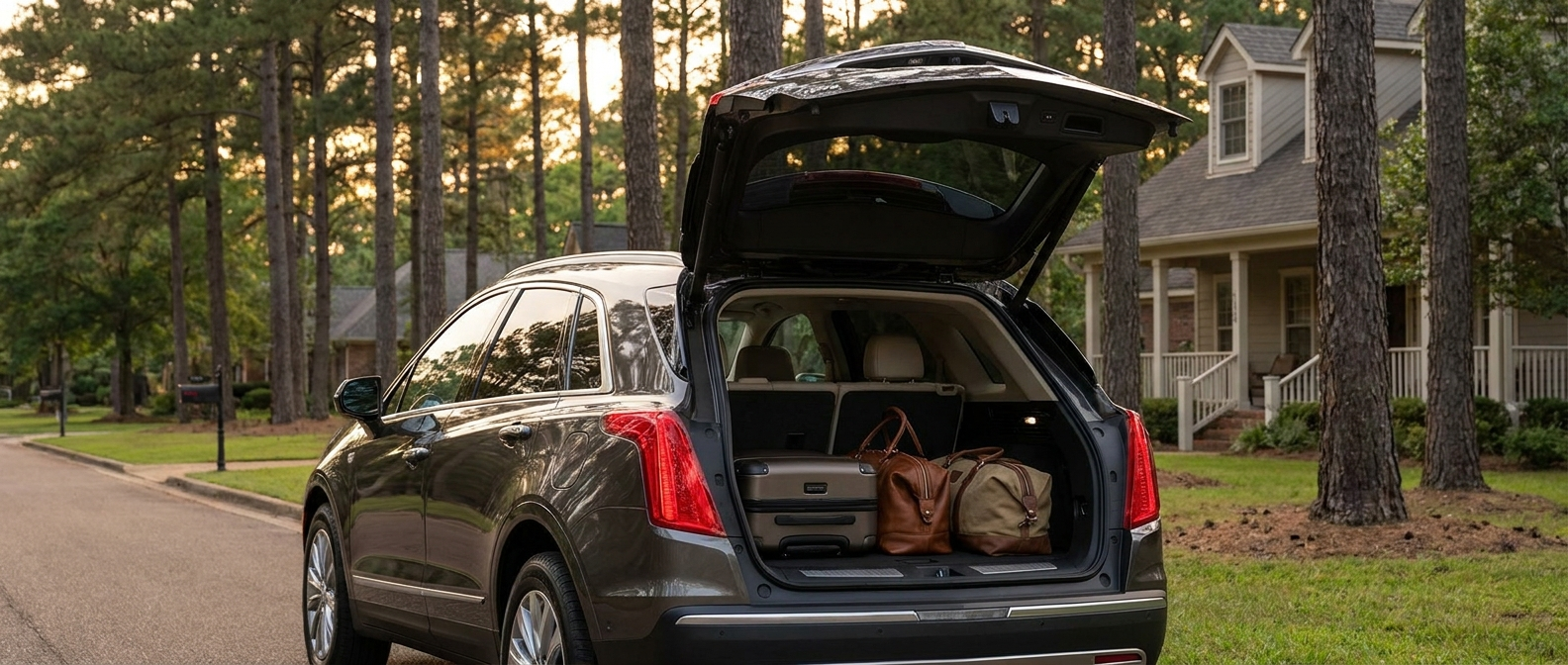
2026 Cadillac XT5 rear cargo area open with luggage loaded, Madison MS

How to Pack Your Cadillac XT5 for a Family Visit from Madison

Family arrives, and the bags multiply. The 2026 Cadillac XT5 gives you 30 cubic feet of cargo space behind the rear seats and 63 cubic feet with them folded, which sounds like plenty right up until you discover that rolling suitcases wider than 41.5 inches won't pass flat between the rear wheel-well humps. Load in the wrong order and you're rearranging luggage in an airport pickup lane. Load in the right order and everyone's bags disappear cleanly, the rear seats stay up for the ride home, and nothing slides. We'll walk the sequence precisely: what to stow before anyone shows up, what goes in first at the curb, and how the XT5's 60/40 split-folding rear seat and under-floor compartment each absorb a specific category of guest gear. The wheel wells narrow the flat cargo floor to 41.5 inches between the humps. Standard carry-on suitcases fit; large checked bags need to go in on their side or at an angle. Plan that before you reach the airport. See current XT5 inventory at Cadillac of Jackson What You Need Before the Family Arrives A quick check of dimensions and the cabin's built-in organization before the airport run saves you the scramble at the curb, and it takes all of five minutes at your own driveway. Walk the numbers once. The 2026 XT5 brings a lot to the task, and most of it is standard across the lineup. Item Spec / Detail Cargo volume (seats up) 30.0 cu. ft. Cargo volume (seats folded) 63.0 cu. ft. Rear legroom 39.0 inches Flat floor width between wheel wells 41.5 inches 60/40 split rear seat Standard on all trims Under-floor storage compartment Standard (beneath cargo floor mat) Cargo tie-down anchors and hooks Standard Cargo area power outlet (12V) Standard Engine (Luxury/Premium Luxury base) 2.0L turbo I-4, 235 hp / 258 lb-ft Engine (Premium Luxury opt. / Sport) 3.6L V6, 310 hp / 271 lb-ft One thing's worth noting before you back in at the pickup lane at Jackson-Medgar Wiley Evers International Airport. The XT5's power liftgate takes a few seconds to fully raise, and arriving passengers tend to grab it and close it before it's all the way up. Let it finish its arc. It won't hurt anything, but it does reset, and that resetting costs you time you don't have when cars are queuing up behind you. The Six-Step Loading Sequence This sequence is the spine of the whole exercise, and the geometry only works if you respect the order. Follow it and the bags fall into place. Skip a step and you're improvising at the curb while a family of four watches you. Step 1. Clear the under-floor compartment and decide what lives there permanently. Lift the cargo floor mat and open the storage well beneath it. That well is the right home for the small items that need to stay reachable throughout the visit (a compact umbrella, since November in the Jackson metro means afternoon showers can appear without ceremony, plus a reusable shopping bag and a phone charging cable for the rear seats). Stash these now and they won't be buried under luggage when someone needs them on the way back from dinner. Step 2. Measure or eyeball the guests' largest bag before you leave home. Seriously, do it. A large checked suitcase (28-inch or 30-inch shell) runs around 20 inches wide and 30 inches tall. Standing upright, it clears the 41.5-inch span between the wheel wells with room to spare, so the issue is length, not width, when bags are standing. If your family travels with oversized duffels or frame-style hiking bags, those may need to go in diagonally across the full 63-cubic-foot footprint with one rear seat section folded. Know that before you park. Step 3. At the airport, open the liftgate and set the loading zone. Our service team sees XT5 owners come in after trips with scuffed cargo liners from one habit in particular, which is sliding a wheeled suitcase straight onto the carpet before the liftgate is fully open. If you don't already have an OEM cargo liner in place, lay a moving blanket or a thick towel at the sill edge. The XT5's rear bumper fascia is painted, and rolling a hard-shell bag across it without protection leaves marks. Step 4. Load heaviest bags first, toward the rear seatbacks. A 60/40 split means you can tilt the larger 60-percent section forward without touching the other side. If you've got one adult with a large checked bag and one with carry-ons only, fold the 60-percent side for the big bag and leave the 40-percent side up for the second passenger's comfort. That configuration keeps three people in the rear seat with cargo behind them. Two large checked bags? Both sections fold flat and 63 cubic feet opens up. With the seats folded, the cargo floor is essentially flat, and that flatness matters for rolling bags. Step 5. Slide carry-on bags into the gaps alongside and atop the larger pieces. A standard carry-on (typically around 22 inches tall) stands between the wheel-well humps without issue. Soft-sided duffels compress into the remaining corners. Coats and hanging bags drape over the top of the pile. Clip anything that feels like it might shift to the tie-down anchors and hooks built into the cargo floor, because the I-55 ramp back toward Ridgeland has a way of finding loose luggage. Step 6. Confirm rear-passenger headroom before driving off. The XT5 gives rear passengers 38.4 inches of headroom. That's a generous number, though taller guests sometimes instinctively recline the seatback a touch for comfort, which shifts the lower seat cushion forward and trims legroom. With 39.0 inches of rear legroom standard, there's room to spare for most adults, so let everyone settle before you close the door. If your family visits include three rows of relatives, the Escalade is a conversation worth having with our team separately. Tip: The step most people skip is Step 2. Knowing the bag dimensions before you leave home costs nothing. Finding out at the curb that a 32-inch frame suitcase won't stand upright behind a folded seat (the cargo floor to the headliner runs around 34 inches in that position) costs you a minute of reorganizing in a no-standing zone. It's a small thing, and it's also the one thing every organized XT5 owner has figured out by the second family visit. [ ] Under-floor compartment cleared and stocked (umbrella, cable, reusable bag) [ ] Cargo liner or protective layer at the sill edge [ ] Guest bag dimensions confirmed in advance [ ] 60/40 seat decision made (which sections fold, if any) [ ] Tie-down anchors identified and ready for loose items [ ] Liftgate allowed to fully open before loading begins [ ] All rear passengers settled and comfortable before departing the airport A Print-and-Go Summary for the Airport Run The night before pickup, run through this once and you'll load clean in the morning. The 30 cubic feet behind upright rear seats handles two standard checked bags and a carry-on comfortably. Fold the seats for the 63-cubic-foot configuration and you'll absorb larger hauls or extended stays with more gear. The under-floor compartment is small, but it's exactly right for the things that need to survive the whole visit without getting buried. Madison sits three miles from our showroom at Cadillac of Jackson in Ridgeland. If you're heading to the airport via I-55, the drive from our lot to Jackson-Medgar Wiley Evers International Airport is straightforward and takes you right past the neighborhoods your guests will be visiting. The XT5's cabin makes that drive feel easy regardless of load, and the cargo planning is what makes the homecoming feel polished. One honest note. The XT5 is a two-row midsize, and it's superb for a family of four plus luggage, or a couple with generous guest bags. It is not the vehicle for five adults plus five checked bags, and that scenario is what the Escalade ESV exists for. We'd rather you know that upfront than discover it at the airport. Frequently Asked Questions Will full-size checked luggage fit in the XT5 with all rear seats up? Two standard checked bags (28 inches or smaller in height) fit behind the upright rear seats in the 30-cubic-foot cargo area. The wheel wells narrow the flat floor to 41.5 inches between them, so bags stand upright without trouble, but very long bags (over 30 inches in any dimension) may need to be loaded at an angle or with one seat section folded. Does folding the rear seats create a fully flat cargo floor? The 2026 XT5's 60/40 split-folding rear seat folds to a nearly flat surface, giving you access to 63 cubic feet. There is a slight ramp angle where the seatback meets the cargo floor, which matters for rolling items. Soft bags handle this without issue; hard-shell rollers may need to be lifted over the transition point rather than slid. Schedule a Pre-Trip Service Check Cadillac of Jackson 700 Adcock St, Ridgeland, MS 39157 (601) 948-5183

2026 Cadillac Escalade in service bay before Thanksgiving tire and brake inspection, Ridgeland, MS

Cadillac Tire and Brake Checks Before Thanksgiving | Ridgeland, MS

November in the Jackson metro means wet roads, not ice. Temperatures here run between a high around 64 degrees and a low near 47 degrees Fahrenheit, and rain falls on roughly 9 days of the month, so the Thanksgiving travel window reads as a wet-pavement problem far more than a cold-weather one. Before your Cadillac joins the I-55 corridor push toward Memphis or the run down toward the Coast, the prep comes down to two things: tire tread depth and brake system condition. Everything else is a distant second. Get those two right and you're composed on the road; get them wrong and no luxury feature makes up the difference. Our 2026 Cadillac XT5 and the full Escalade family are built to handle exactly this kind of sustained highway load, but only if the contact patch and stopping system underneath aren't already worn down. The Pre-Thanksgiving Do and Don't Table Our service team runs this same check before any significant drive, and when it's scheduled the whole thing takes less than 30 minutes. That window answers every question that matters. Check Do Don't Tread depth Verify all four tires measure 4/32" or deeper before departing Rely on the legal minimum of 2/32". Mississippi has no specific tread statute, and that depth is not a safety standard Brake Pad Life Monitor Review the percentage for both axles in your Driver Information Center before you leave Assume the monitor covers everything; listen for audible wear indicators too Tire pressure Check cold pressure the morning before departure, against the placard in the driver's door jamb Check pressure immediately after highway miles, when heat has expanded the reading Sidewall condition Inspect for bulges, cracks, or any deformation along the sidewall Skip this step because tread looks fine, the sidewall and tread fail independently Rotor feel Note whether the pedal is firm and returns cleanly to height; a pulsating pedal is a signal Dismiss minor pedal vibration as "normal"; it typically indicates disc thickness variation Brake fluid Confirm fluid is at the full mark and shows clear color Ignore dark or milky fluid, which absorbs moisture over time and raises the boiling point threshold The Number That Actually Governs Wet Stopping Distance The 4/32" tread threshold is the most consequential pre-trip check you can make before a holiday drive, and physics is the reason it's more than a polite suggestion, because wet pavement doesn't care what your tires looked like last spring. Even the difference between 4/32" and 2/32" of tread can decide whether you stop at an intersection or on the other side of it. Independent testing from 60 mph on wet pavement shows tires at 4/32" required 65 additional feet to stop compared to new tires, while tires at the barely-legal 2/32" required 71 additional feet further still. On a wet I-55 at Thanksgiving traffic speeds, with lane changes and merge events compressed by holiday volume, that extra footage isn't abstract. Mississippi has no specific tread depth statute, and that matters because there's no legal floor to lean on as a practical guide. Use 4/32" as the number. At that depth wet-road traction stays predictable and hydroplaning risk sits in a manageable range. The quarter test tells you where you stand without tools. Insert a quarter into the tread groove with Washington's head pointing down, and if the top of his head is visible, you're at or near 4/32" and approaching the replacement threshold. The penny test (Lincoln's head) confirms the legal minimum of 2/32", but that's the floor, not the target. For the Escalade and Escalade ESV, tread depth matters even more because of vehicle mass. A heavier platform needs more tread groove to channel standing water efficiently, so what's adequate on a lighter vehicle can fall short on a full-size three-row. Our team's observation: The Cadillac Brake Pad Life Monitor on 2026 models uses thickness sensors embedded in the front and rear pads to calculate remaining pad life and displays it as a percentage in the Driver Information Center. A reading below 20% warrants a service appointment before departure. The monitor estimates from sensor data and typical driving patterns, yet sustained high-speed highway driving, especially with a full passenger load, draws on the braking system differently than a daily commute. The monitor is only an estimate, and it can read optimistic on a loaded holiday run. If you're close to that threshold, schedule service before you leave. A Clean Pre-Trip Inspection Closes the Gap At every 7,500-mile service interval, Cadillac's schedule calls for tire rotation and brake pad inspection as standard items, but Thanksgiving timing rarely lines up with a scheduled interval, and that's the gap a pre-trip visit fills. A pre-trip service appointment gives our technicians the chance to measure tread depth across all four tires with a calibrated gauge (inner, center, and outer groove), confirm brake pad thickness on both axles, check rotor surface condition for disc thickness variation, verify tire pressure against the door placard specification, and inspect brake fluid clarity. It's a targeted inspection, not a full service. It takes a fraction of the time, and it produces a confirmed answer rather than a reasonable guess. The Wednesday before Thanksgiving, between 2 p.m. and 6 p.m., is historically the worst traffic window, with congestion running two to four times normal levels in major metro areas. Scheduling that inspection in the days before you join that flow means you won't be making a maintenance decision in a rest-stop parking lot. The composed, quiet drive your Cadillac delivers on a long Mississippi highway run depends on what's happening at the four corners. Tread and brakes are where it begins. Schedule a Pre-Trip Service Inspection Cadillac of Jackson 700 Adcock St, Ridgeland, MS 39157 (601) 948-5183